

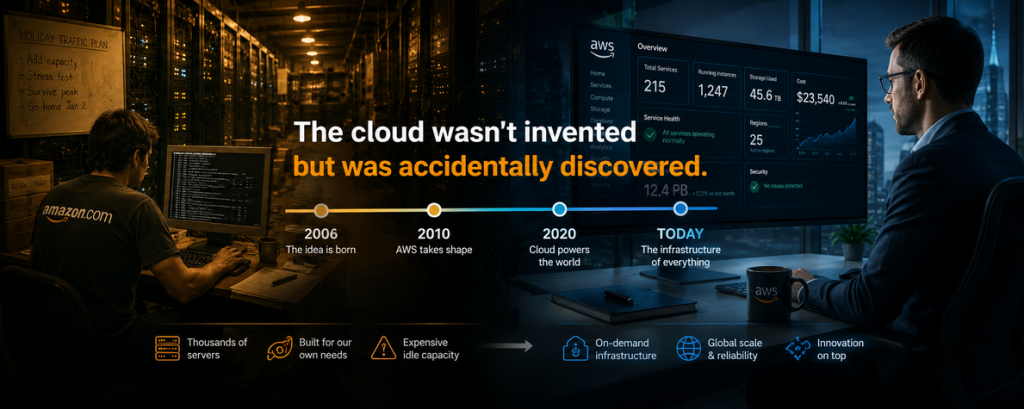
Every year, for about six weeks, Amazon had a problem that cost it millions.
The weeks between Thanksgiving and Christmas were their Super Bowl: orders flooding in, warehouses buzzing, servers screaming under the load. And to handle it all, Amazon had built a colossal internal infrastructure: thousands of servers, enormous storage systems, custom databases, and software tools so sophisticated they rivalled anything in Silicon Valley.
Then January came. And most of it just… sat there.
For ten months of the year, Amazon was paying to maintain an infrastructure it was barely using. Idle servers. Cooling costs for machines doing nothing. Engineers are maintaining systems that have no traffic. It was, by any financial measure, a disaster hiding inside a success story.
In 2003, a small team inside Amazon, led by engineers Andy Jassy and Werner Vogels, started asking a question that seemed almost too obvious: What if we rented this out?
The idea that almost didn’t happen:
The proposal wasn’t glamorous. It wasn’t a moonshot. It was, at its heart, a landlord renting out spare rooms. But when Jeff Bezos heard it, he saw something most people didn’t: the infrastructure Amazon had built to run its own business was so sophisticated, so resilient, and so scalable that other companies would pay serious money to use it rather than build their own.
In March 2006, Amazon launched S3: Simple Storage Service. Three months later, EC2 followed: Elastic Compute Cloud. For the first time in history, any company, from a two-person startup in a garage to a Fortune 500 enterprise, could rent world-class computing infrastructure by the hour, with no upfront cost and no long-term commitment.
The internet changed that day. Most people just didn’t notice.

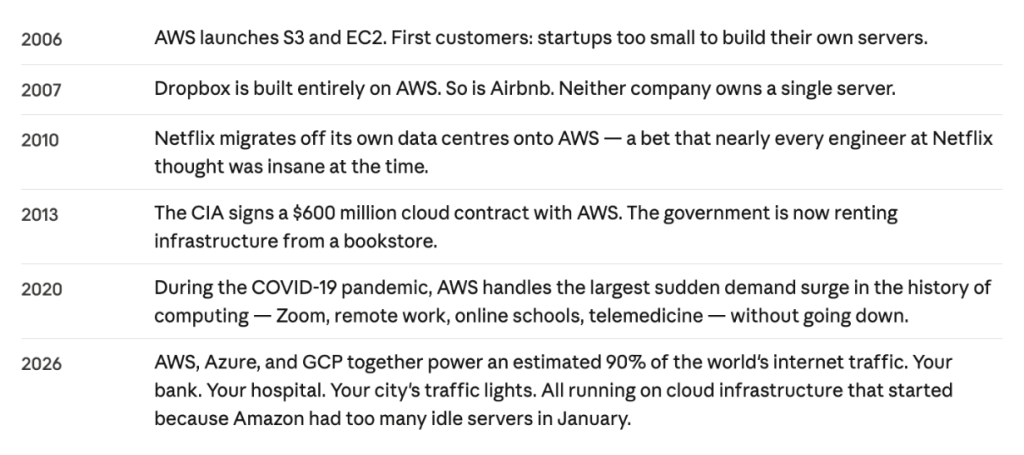
What happened next shocked everyone, including Amazon:
The lesson every business leader is missing:
Here’s what the history of cloud computing actually teaches us, and it’s not what most people say.
The popular narrative is “Amazon was smart; they saw the future early.” But that’s not what happened. Amazon didn’t have a vision for cloud computing. They had a problem. A very expensive, very embarrassing problem: infrastructure they couldn’t fully use. The cloud was the solution to their problem, not the execution of their vision.
The businesses that fell behind weren’t the ones that failed to predict cloud computing. They were the ones who, once the cloud existed, spent years arguing about whether they “really” needed it. Whether it was “really” secure. Whether it was “really” worth the change management effort.
By the time they finished the debate, Airbnb had no physical hotel rooms and was worth more than Marriott. Netflix had no physical media and had killed Blockbuster. Zoom had no offices of its own and had made office buildings temporarily irrelevant.
We are watching the exact same dynamic play out right now, except the technology is AI running on cloud infrastructure. And the companies still in the “is this really necessary?” phase of the debate are about to find out what Blockbuster found out.
Where Bell Blaze Technologies fits in this story:
We exist at the intersection of the two biggest technology shifts in the history of business: cloud infrastructure and artificial intelligence. Both of them started the same way as solutions to specific problems, not grand visions. Both of them rewarded the companies that moved, while others debated.
The question we ask every client isn’t “Are you ready for AI and cloud?” The question is, what is your most expensive problem right now, and how quickly can we solve it using the existing infrastructure?
Amazon’s engineers asked a version of that question in 2003. The answer they found changed the world.
What’s the version of that question your business needs to ask in 2026?
At Bell Blaze Technologies, we help businesses design, deploy, and optimize AI and cloud solutions that solve real operational problems. If your team is still in the “evaluation” phase of your AI or cloud journey, we’d love to show you what month one looks like in practice.
Drop a comment below or send us a message. We read everyone.
#CloudComputing Amazon Web Services (AWS) #DigitalTransformation #TechHistory #Innovation #BellBlaze #ArtificialIntelligence #BusinessStrategy #AIHistory #MachineLearning #TechLeadership #FutureOfBusiness #AWS